Abstract#
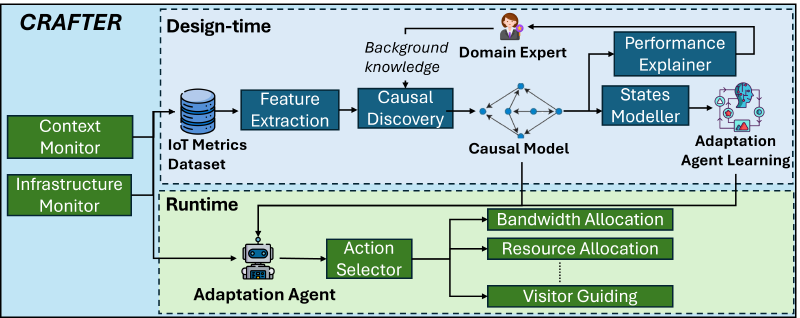
This paper presents CRAFTER, an automated framework for designing and deploying self-adaptive IoT systems using Causal Reinforcement Learning (CRL). As IoT devices increasingly populate pervasive computing spaces, smart environments are enabled with advanced monitoring and interactive services. The dynamic nature of these environments, such as fluctuating workloads and evolving application demands, poses significant challenges in maintaining consistent Quality of Service (QoS) levels of IoT applications. While existing self-adaptation techniques offer adaptive capabilities, they are often designed to deal with specific application domains, hindering the design of self-adaptive solutions that can be re-used across multiple IoT verticals. In addition, there is a lack of automated pipelines that act on identifying key performance drivers to take effective adaptation decisions. CRAFTER addresses these issues by using Causality as a formal framework for performance analysis of IoT systems. CRAFTER generates causal graphs to uncover dependencies among system components and guide adaptation decisions based on cause–effect relationships. Then, adaptation agents can leverage this knowledge to take more effective adaptation decisions in dynamic situations. Our experimental evaluation demonstrates how CRAFTER enables deriving causal graphs spanning diverse IoT use cases. Furthermore, we showcase how CRAFTER improves self-adaptation performance by 25% compared to state-of-the-art Reinforcement Learning-based approaches.